How Many Jumps Are There In The Grand National

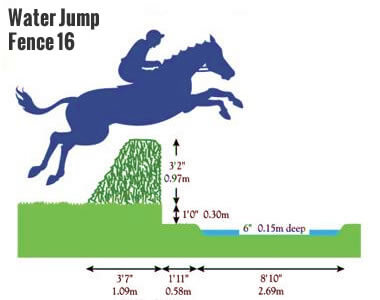
30 Jumps – 16 Fences. The Grand National is renowned for being one of the most difficult horse races in the world. The gruelling four and a half mile course has 30 jumps of varying difficultly for the brave jockeys and horses to navigate. Around 60% of the horses that start the race will not make it past the finishing post, and for the first horse over the last fence a 494 yard marathon run-in awaits. How many jumps are there in the Grand National? Horses have to jump 30 fences during the Grand National. What time is the main race? The main race at the Grand National festival is the Grand National itself. It takes place on the Saturday of the three-day meeting at 5.15pm. What is the oldest horse to win the Grand National?
The Chair is a fence on Aintree Racecourse's National Course and thus is one of 30 that are jumped during the Grand Nationalsteeplechase which is held annually at the racecourse near Liverpool, England.
It is the 15th fence that the runners jump and is one of only two (the other being the 16th, the Water Jump) in the race to be negotiated only once.[1]
Positioned in front of the grandstand, it is the tallest fence on the course, at 5 feet 3 inches (1.60 m),[2] preceded by a 6 feet 0 inches (1.83 m) open ditch on the takeoff side. The Chair is also comfortably the narrowest fence on the Grand National course, bar the Water Jump. The landing side of The Chair fence is actually 6 inches (15 cm) above the ground on the takeoff side, creating the reverse effect to that at the Becher's Brook fence, meaning the ground comes up to meet horse and rider sooner than anticipated.[1]
Generally it is jumped fairly safely by most horses in the Grand National field, probably due to the lengthy run they have before reaching the fence, and because, by the time the fence is approached, most of the runners have settled into a smooth running rhythm. However, it regularly claims fallers, not just in the Grand National but other races held over the course. Perhaps The Chair's most notorious pile up occurred during the 1979 Grand National,[3] won by Rubstic. Two loose horses veered across the main body of the field and contributed to the falls or refusals of nine horses, including Kintai who had to be euthanised as a result of injuries sustained when he was brought down.[4] For the following year's race, in which Ben Nevis returned and won having been one of the victims in the prior year's pile-up, channels were installed around the fence so that loose horses reluctant to negotiate the obstacle were able to bypass it rather than jump over it. There has been no equine fatality in the Grand National at The Chair since 1979, and only three at the fence since the race was founded in 1839.
The Chair has also claimed the life of the only human fatality in a Grand National when Joseph Wynne, the son of former winning jockey Denny Wynne, was badly injured in a fall at the fence during the 1862 running. Although taken alive from the course to the nearby Sefton Arms pub, he died hours later, never having regained consciousness.[5] Former winning jockey George Ede, who rode under the name Mr. Edwards, also lost his life in a fall at the fence in 1872, albeit not in a Grand National.[6] In the 1964 Grand National, rider Paddy Farrell fractured his spine in a fall at The Chair. His plight highlighted the lack of support for jockeys who are badly injured in racing, leading to the creation of the injured jockeys' fund.[7]
The fence has caught out numerous Grand National winners over the years, including Russian Hero (1951), Ayala (1964), Rubstic (1980)[3] and Silver Birch (2006).
The Chair receives its name from the chair once sited alongside the fence, at which a distance judge would sit when races used to be run in heats. Horses that tailed off too far were disqualified from later heats.[8] In the 19th century the fence was more widely known as The Monument, but this term began to fall out of favour during the 1890s, although it was still occasionally used in the press up to and during the 1920s.
Number of fallers[edit]
This table documents the number of runners which fell in recent Grand Nationals at The Chair, including those who unseated riders or were brought down, but not those who were pulled up, carried out or refused at the fence:
| Year | Falls |
|---|---|
| 2019 | 0 |
| 2018 | 2 |
| 2017 | 1 |
| 2016 | 2 |
| 2015 | 0 |
| 2014 | 1 |
| 2013 | 1 |
| 2012 | 1 |
| 2011 | 0 |
| 2010 | 1 |
| 2009 | 1 |
| 2008 | 0 |
| 2007 | 0 |
| 2006 | 3 |
| 2005 | 1 |
| 2004 | 1 |
| 2003 | 1 |
| 2002 | 0 |
| 2001 | 3 |
| 2000 | 0 |
| 1999 | 0 |
| 1998 | 0 |
| 1997 | 1 |
| 1996 | 0 |
| 1995 | 0 |
| 1994 | 2 |
| 1993* | 0 |
| 1992 | 1 |
| 1991 | 1 |
| 1990 | 1 |
| 1989 | 0 |
| 1988 | 0 |
*Race void
References[edit]
- ^ abPitman, Richard (25 March 2004). 'Richard Pitman's Aintree course guide'. BBC Sport. Retrieved 23 November 2010.
- ^'Aintree Grand National Fences'. Aintree Grand National. Retrieved 15 November 2010.
- ^ abBaker, Andrew (5 April 2008). 'Grand National guide to the fences at Aintree'. Daily Telegraph. London. Retrieved 23 November 2010.
- ^http://www.grand-national.me.uk/rubstic.php
- ^'Archived copy'. Archived from the original on 9 June 2012. Retrieved 7 May 2013.CS1 maint: archived copy as title (link)
- ^http://bet-grand-national.com/george-ede-edwards/
- ^Yates, Dave (27 November 1999). 'Obituary: Paddy Farrell'. The Independent. London.
- ^Vamplew, Ray; Kay, Joyce (2005). Encyclopedia of British horseracing. Routledge. pp. 99–100. ISBN978-0-7146-5356-3. Retrieved 23 November 2010.
Australian Racing: The Grand National Hurdle
By Kristen Manning
Victoria’s version of The Grand National Hurdle, a race which boasts a 136 history, has seen many changes in recent times – switching from its traditional venue at Flemington to Sandown.
In 2015 run at Warrnambool whilst work took place at Sandown, it is probably the only feature race to have been run on some many different tracks!
Which detracts nothing from the quality of the race, a tough test with an honour roll that includes some of the great Australian jumpers.
As we prepare for this Sunday’s edition, one that has attracted a field of ten horses from Victoria’s leading jumping stables, it is timely to have a look back at some of the great Grand National winners.
An historic stand-out is the 1888 version won by Malua, a remarkable race for a couple of reasons – firstly because the winner was an entire, secondly as he was ridden to victory by his owner John Inglis and thirdly because the horse had five years previously won the Melbourne Cup!
Generally acknowledged as the most versatile high class horse ever to race in Australia Malua, whose career kicked off with three wins in Tasmania at two (then named Bagot), also won two feature sprints (the Newmarket Handicap and the Oakleigh Plate) as well as an Australian Cup, an Adelaide Cup, a Geelong Cup and a Melbourne (Mackinnon) Stakes.
And to put a seal on his great career, Malua went on to sire a number of stakes winners including a Melbourne Cup winner (Malvolio), a Caulfield Cup winner (Ingliston) and a Newmarket Handicap winner (Maluma).
The following year’s Grand National was won by just as remarkable a horse, the incredible Redleap. A horse who wrote his name in history books despite racing just seven times; his career hindered by recurring bouts of laminitis. He ovecame that significant setback to win the Grand National on two occasions; the first with 61kg, the second three years later with 74 1/2kg. Which was somewhat of a light impost compared to the 84kg and 88kg he carried to steeplechasing feature victories!
Don Quixote carried all the more winning the 1884 Grand National with 76kg whilst in 1930 the champion Mosstrooper took out the race with 74 1/2 kg, also taking out the Grand National Steeplechase.
In 1943 tough mare Claudette claimed a Grand National and like Malua she was also high class on the flat, winning three stakes races and finishing third in Spearfelt’s Melbourne Cup.
How Many Jumps Are There In The Grand National Park
The early 1970s saw Robert win a pair of Grand Nationals, an achievement equalled by Airmond in 1980 and 1982 and by Sir Agrifo in 1987 and 1989 – the era of Jim Houlahan domination.
What a remarkable story Jim Houlahan was, not embarking on his training career until the age of 57, from thereon cheering home seven Grand National winners – one of many feats that saw him inducted into the Australian Racing Hall Of Fame in 2004.
One of his finest jumpers, Sir Agrifo competed in no less than five Grand National Hurdles.
The year after Sir Agrifo’s second Grand National success Sharp As won the big race, a horse whose great natural talent made him a yardstick, this statement so often heard… “the best since Sharp As.”
2002 saw Zabenz by champion stallion Zabeel claim victory by ten lengths. And he took that form with him overseas, a couple of months later winning a feature steeplechase at Saratoga.
How Many Jumps Are There In The Grand Nationals
Five years later Some Are Bent was a dominant winner and his brother Black And Bent made it a family affair winning the 2011 and 2013 editions, the second of those at his final outing… going out in style!
Another story will be told on Sunday, be sure to tune in.
Kristen Manning is a freelance racing writer and pedigree analyst based in Melbourne. A keen owner/breeder who loves every aspect of thoroughbred horse racing, she has written two books focusing on the deeds of Fields Of Omagh and Prince Of Penzance.
How Many Jumps In The Grand National 2019
The following two tabs change content below.- Ethereum Update: $2000 in Range - March 9, 2021
- The Bitcoin Report - March 9, 2021
- China and the High Tech Future - March 9, 2021