How To Signal Double Down In Blackjack
When playing blackjack at a physical or land-based casino, the most frequent decision you’ll have to make is whether to hit or stand. While you can gain a feel for this over time simply through experience, you can expedite the process by studying up on the best moves to make in any given situation. If you’re ready to win more cash during blackjack games, read our handy guide to learn when to hit and when to stand.
Master the Basics
Before we delve into strategies, we want to make sure that you have a firm grasp on the basics of hitting and standing. The main premise of blackjack is to get a hand whose total exceeds the dealer’s hand, but without going over 21. When you hit, this means that you want to draw another card to try to improve your hand’s total. Conversely, when you stand, you are satisfied with your hand’s total and don’t want to draw any more cards. If you signal to the dealer that you want to stand, your hand for the round is completed. If you hit and your hand exceeds 21, you’ve busted.
We have two important gambling terms for you to memorize before learning strategies: hard hand and soft hand. A hard hand is any hand that doesn’t contain an ace, or in which an ace’s value is only 1. A 10-8 and a 7-A-10 hand are both hard 18s. A soft hand contains an ace that’s counted as an 11. For instance, an A-7 hand is a soft 18. If one of the first two cards you are dealt is an ace, you have a soft hand. This gives you an advantage. The ace has a value of 11, but if you take a hit and go over 21, its value reverts to 1. This eliminates the risk of busting after that hit, thus giving you the freedom to make moves that would normally be risky.
Now that you know the basic definitions, we’ll go through the circumstances in which you should hit or stand. We’ll provide you with the best strategies, as well as blackjack hit/stand tables that you can save for future reference.
Hitting and Standing with a Hard Hand
When playing blackjack with a hard hand, we would recommend the following:
- When you are dealt a total of 5-8, always hit.
- When you are dealt 9, hit if the dealer shows a 2 or a 7 through ace.
- If you have 10, hit if the dealer shows an ace or a 10.
- If your hand is 11, hit only if the dealer shows an ace.
- For a hand of 12, stand if the dealer shows a 4 through 6. If they show a 2, 3, or a 7 through ace, hit.
- When you have a hand of 13 through 16, stand if the dealer reveals a hand of 2 through 6. Otherwise, hit.
- When you are dealt 17 through 21, you should always stand.
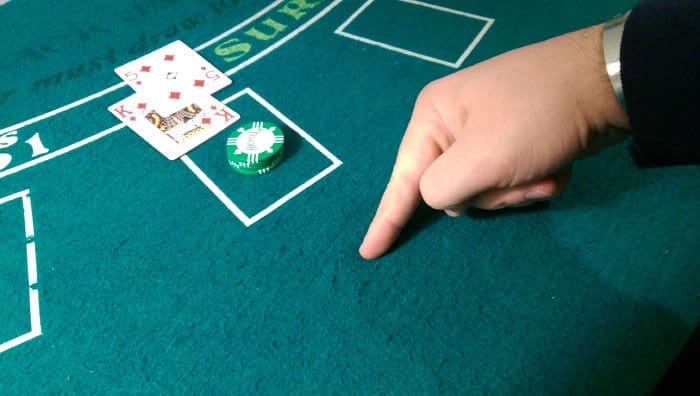
What Is Double Down in Blackjack? You can double down after you’re dealt your two hole cards, which means you have the option to double your bet and receive exactly one more card. Then, if you haven’t gone bust already, the Dealer plays, and the winning hand is declared. If you’re playing at a live casino, take however many chips you need to match your original bet, and place them nearby – but outside the. In most cases, you will be allowed to double down on your first two cards while some casinos may allow you to double down on a Blackjack hand. Another situation in which you can double down is after splitting two cards of the same value while at some casinos you can use the double down option only on hard 9, hard 10 or hard 11.
Reference Chart
Blackjack hit or stand on a hard hand cheat sheet.
If you’re playing a multi-deck game and you have a hard 17, double down instead of taking a hit.
You’ll need to make some minor tweaks to our strategy, depending on the number of decks and rules you’re playing with. If you’re playing in a double-deck game, don’t hit when you have a 9 and the dealer has 2. If you have an 11 against the dealer’s ace, don’t hit either. In both cases, you should double down.
And lastly, if you’re playing in a single-deck game, double down under the following circumstances:
- You have 8 and the dealer has 5 or 6.
- You have 9 against the dealer’s 2.
- You have 11 and the dealer has an ace.
Hitting and Standing With a Soft Hand
Remember, you can’t bust a soft hand with a one-card hit. Taking that into consideration, our strategy for playing with a soft hand is much simpler than our hard hand strategy. Keep the following moves in mind:
- If you have a soft 19 or 20, you should always stand. You are unlikely to get a stronger hand than this.
- For a soft 18 against the dealer’s 2 through 8, stand. If the dealer shows 9, 10, or an ace, hit.
- If your total is soft 17 or less, you should always hit.
What Are Your Other Options?
Hitting and standing aren’t the only options available to you in a game of blackjack. The following moves are also possible:
— Split. If you are initially dealt two cards of the same value, you can split your hand. You’ll place an additional wager equivalent to your first one, and then manage two hands rather than 1.
— Double Down.Gamblers can increase their potential profits with this move, but it comes with some inherent risk. To use this move, you must double the size with your bet and then receive one more card. After that, you must stand.
— Surrender. If you are not confident with your chances of winning the round, you have the option to surrender. When you use this move, you will only lose half of your bet.
Where to Play Blackjack Online
Are you ready to put your newfound knowledge to the test? Check out Bob Casino! Our library of online casino games contains numerous varieties of blackjack. You can play for free until you master your hit and stand strategies. When you’re confident in your skills, you can even try your hand at winning real money. Come create an account at Bob Casino today for the ultimate gambling experience.
Related posts:
No related posts.
Blackjack is one of the most popular table games online and in land casinos. It has plenty of variations differing in rules and details. In some of the blackjack variations, there is a surrender decision available to the player. This move can be a lifesaver in the game if used correctly, especially if you know a good card counting method. Here are a couple of tips on how to use this move.
What Is Surrender?
Surrender is a solution that ends the game and saves half of the player’s bet. Most of the players ignore this move as they feel it’s useless. It is usually explained by the fact that you always have chances to win no matter which cards you get. Well, the thing is that in Blackjack, you also should consider the dealer’s upcard, as that is a crucial factor to consider.
Of course, you always have a chance to win no matter which combination you initially get. And still, experienced players always evaluate their chances, preferring to give up, when they are low. This can be a useful solution, as it allows you to cut your losses twice in bad games.
It has to be mentioned that casinos know how valuable surrender solution can be, and some of them forbid that move for Blackjack. Thus, for any player who wants to increase their chances of winning and improve results, it is a good idea to have a clear understanding of how to use this solution.
Blackjack Surrender Rules
As already mentioned, some Blackjack games support surrender solutions, and others don’t. Even among the games that support surrender, there can be different variations to the rules. Thus it is better to clarify them on the website if you play in an online casino or from a dealer if you play in a land casino. However, generally, the standard rules of Blackjack with surrender enabled look like this:
- Dealer stands on 17.
- Split is available, resplit is not.
- If splitting Aces, you can only take one card afterwards. If you get 10 for any Ace hands, you get 21, not a natural Blackjack.
- For natural Blackjack, the payment is 3:2
- Double down enabled.
- 7 Card Charlie is enabled and is beaten only by natural Blackjack.
- The bet can be insured if the dealer has an Ace.
No matter which kind of Surrender Blackjack you are playing, there are common things that all players need to know:
- Surrender is only available on the initial hand. Sometimes you can surrender before the dealer opens the hole card, which is called early surrender. Sometimes, you can surrender only after the dealer opens the hole card, which called late surrender.
- The surrender option is useful when your chances of winning are less than 25%.
Peek Rule
The peek rule is about the situation when the dealer’s upcard values 10 or is an Ace. In such an occasion, a player can peek at the second card of the dealer’s initial hand, and the game is over if the hand values 21. For example, in case the dealer has an Ace upcard, you can watch the second one, and if it values 10, end the game, as it would be useless to continue it.
7 Card Charlie
As we all know, if the value of your hand exceeds or equals 21, the game is ended. 7 Card Charlie is a situation when you have 7 cards in your hand, and the sum equals or doesn’t exceed 21.
That means you win only if the dealer doesn’t have a natural Blackjack. For example, if you have 2, 3, Ace, 4, 3, 2, 4 – which equals to 19 with 7 cards, you win the game only if the dealer doesn’t have 21 with an Ace in hand.
When You Should Surrender in Blackjack
Generally, for Blackjack with surrender solution enabled, the dealer stands on 17. Thus, it would be best if you always surrendered on:
- Dealer’s Ace, 9, 10 if you have a hard 16 (except 8-8, when it is better to split)
- Dealer’s 10 upcard, if you have a hard 15.
This is the most basic strategy for the surrender solution that can be used by beginners. It has to be mentioned that the number of decks and availability of early or late surrender have a great impact on the way the surrender move has to be used. Continue reading below to get a more detailed description of the strategies depending on the Blackjack rules.
Early Surrender Strategy
Early surrender means that you can use the surrender solution before the dealer reveals the second card in their hand. Thus, due to proper card counting, you should surrender when:
- The dealer has an Ace
- You have hard 5-7, 12-17
- You have pairs 3-3, 6-6, 7-7, 8-8
Or:
- The dealer has a 10
- You have hard 14-16
- You have pairs of 7-7, 8-8
However, using these moves can be conditional, depending on the Blackjack game rules. Thus, there are exceptions to consider:
- Single deck Blackjack: do not surrender if the dealer has 10, and you have 10-4, 5-9
- Double-deck Blackjack: do not surrender if the dealer has 10, and you have 10-4
- Dealer hits on soft 17: surrender if you have a pair of 2-2 against the dealer’s Ace
- Double down after split allowed: do not surrender if the dealer has 10 and you have a pair 8-8
Let’s make an example.
Dealer: Ace
You: 6-7
As you can see, the dealer has an Ace, and the second card is not revealed yet. You have 6-7, which totals 13. You cannot split, as you did not get a pair of same cards. What you can do is either hit, double down or surrender.
In case you choose the surrender option, you will get half of your bet back. In case you double down or hit, your chances to win are less than 25%. Thus, the best option would be to surrender.
To make it more convenient, check this table for an early surrender strategy. Consider that it is eligible for games when:
- Dealer stands on soft 17
- Double down after split allowed
Late Surrender Strategy
In most casinos, you can surrender your hand only when the dealer opens a hole card. That means that if the dealer has a 10 or an Ace as an upcard, and he opens a hole card that gives his hand a natural Blackjack, surrender is no longer available, and you will lose all of your bet. That is why it’s called late surrender. Games with the option of late surrender are less profitable for the player than the games with early surrender.
As for early surrender Blackjack, you can surrender before the hole card is revealed, so if the dealer has a natural Blackjack in the initial game, you can get at least half of your bet and avoid making double down as well.
This fact is one of the reasons strategies for late surrender and early surrender differ. When it comes to the games with late surrender strategy enabled, there are two main factors affecting your choice upon surrender solution:
- Actions of the dealer on soft 17(hit or stand)
- Number of decks (1, 2, 3, 4, 5, 6 or 8)
For the late surrender strategy, an advanced or basic strategy can be used. Basic strategy only considers:
- value of the player’s initial hand
- value of the dealer’s upcard (whether it is 9, 10 or Ace)
- number of decks
The advanced strategy considers not only the value of the player’s card but also the exact combination of the cards in hand.
Here is how the basic strategy upon surrender decision-making looks if you get a hard 15-17 in four or more deck blackjack:
- Do not surrender if the dealer gets 9 or Ace standing on soft 17
- Surrender if the dealer gets 10 or Ace and hits on soft 17
If you get a hard 16:
- Always surrender
- Exception: you get 8-8 and double down after the split is allowed
If you get hard 17:
- Never surrender if the dealer has 9, 10
- Surrender if the dealer has an Ace and hits on soft 17, do not if he stands on soft 17
As late surrender decision-making in Blackjack varies slightly due to factors such as the number of decks or the dealer’s moves on soft 17, it is better to see what the basic strategy should look like in the table:
Here is how the advanced strategy looks in the table (double down after split allowed):
Blackjack Surrender Chart
Blackjack Double Down Strategy

The chart below is designed to show you the best solutions upon the initial hand. It is best applicable for those who want to use the surrender solution in games where this option is enabled. Here you can see three separate tables, when you get pairs, Ace, and hard value in the initial hand.
Tips for Surrender
Surrender is a player’s solution that must be used wisely. It is best to learn all about the other solutions available to you, before you get to advanced usage of surrender, as all in all, it is more about cutting your losses, not winning a game. Below, you can see valuable tips on this solution, which you can use for your good:
- Surrender solution is not always available in casinos – clarify this with the dealer if you are playing in a land casino, or read the rules of the Blackjack game you play. Usually, if surrender is supported, it is pointed out in the game description or on the casino website.
- The surrender solution can be a very valuable move for players, so some of the casinos, both land and online, do not allow it.
- This option is valuable for those who count cards, and when you know how to use other Blackjack solutions, otherwise there is a high chance that advanced usage of this move will be useless for you.
- The solution is valuable in the long run, so those who want to play and adhere to a specified strategy can benefit the most from the exploitation of the surrender move.
- Even if the surrender solution is available, there still can be variations enabled, so check the rules thoroughly. For example, some casinos only offer early surrender (player can surrender after he/she saw the dealer’s upcard valuing ten or Ace, others offer late surrender (even if the dealer has an Ace or ten, the player should wait until the hole card is revealed, and in the case that it gives a hand natural Blackjack, the surrender option will no longer be available).
- Depending on the rules of the land casino you play in, the surrender option can be either chosen verbally or with a signal. Clarify that with the dealer.
Surrender FAQ
How to Surrender in Blackjack?
Is Surrender Allowed in Las Vegas Blackjack?
Other Blackjack Strategies
Along with the surrender, there are also other solutions – hit, stand, double down, and split. Wise usage of these combinations and card counting can bring you better results than using only one of them.
Double Down
Double down is a solution that allows you to increase the bet after you receive your initial hand. Afterwards, you can only take one card. The bet can be increased by 100% or up to 100% -it depends on the game variation you play.
Split
Split is a move that allows you to get two hands instead of one. When you get a combination of cards with the same value (8-8, 9-9, etc.), you can do a split. Afterwards, you place an additional bet for the second hand, and each hand is played solely, so you can win with one hand and lose with the second one.

Hit & Stand
When To Double Down Blackjack
Hit is a solution to take one more card. The hit move can be made as many times as you want until the value of the hand makes or exceeds 21.
How To Signal A Double Down In Blackjack
Stand means that you stop taking more cards. Choose this option when you think that you already have received the best combination in the round. Hit & Standare the basic moves in Blackjack.