How Much Would I Win If I Bet
If you’re going to bet on sports, you need to understand the odds before you put any cash down. There’s no way for you to know the risk involved in your particular wager or the potential payoff unless you know how betting odds work. If you’re looking for the best odds at an online sportsbook, be sure you check out Bovada.
- How Much Would I Win If I Bet On The Chiefs
- How Much Would I Win If I Bet $10 On Roulette Green
- How Much Would I Win If I Bet 100 On The Chiefs
- How Much Would I Win If I Bet On The Bucs
- How Much Would I Win If I Bet On The Browns
The lower the probability of winning (and the higher the risk), the bigger the potential payout is for the moneyline. If you bet $100 on a -130 moneyline favorite (lower risk), you could win $77. If you were to bet $1 on the Packers and they won, you would receive $2.30. $1 of this would be your original bet, and $1.30 would be your profit. As you can tell in this example, the Cowboys are the favorites to win the game. A completely even money bet would be 2.0. This means that if you bet $100 on this bet, you would profit $100.

- If a team was at +140, that means you only have to risk $1 to win $1.40 or $100 to win $140. The key thing to keep in mind is that the payouts are constant regardless of how much you bet. To figure out the exact amount of risk/return, just divide the moneyline by 100. So if it’s -240, you take.
- These odds are based on winning $100 for a given bet. Betting a Favorite: The odds for favorites will have a minus (-) sign, and represent the money you need to risk to win $100. So if you're betting on the Packers at -140 against the Vikings, that means Green Bay is a slight favorite.
It’s essential to understand that odds are a determination of how a specific event may play out. They are not saying that the event will end in the manner predicted. They predict the likelihood of an outcome.
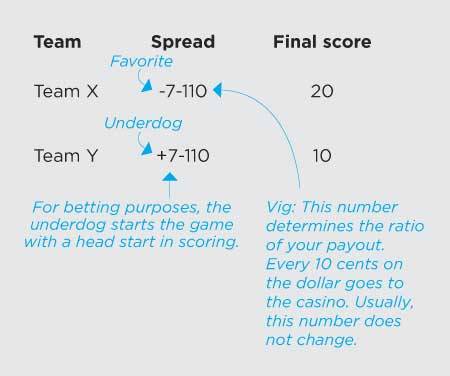
Those wagering on the favored team usually do so at a disadvantage, while those wagering on the underdog are given an edge. Sportsbooks do this in an attempt to even out the bets so that there’s an equal amount of cash placed on each team.
North Carolina is an underdog at +135 and since they are the underdog, you make more than you bet if they win. A bet on North Carolina would pay $135 for every $100 you bet. When betting on favorites to simply win, you won’t be getting as much as you bet.

When wagering, you’ll find that there are three basic ways that odds are listed:
Enter the odds in any format and click Convert
Odds Conversion Guide
To convert decimal odds to fractional, subtract 1.00 and then find the nearest whole integers (so 3.75 - 1.00 becomes 2.75/1, or 11/4).
To convert moneyline odds to decimal, if the moneyline is positive, divide by 100 and add 1. If it is negative, divide 100 by the moneyline amount (without the minus sign) and add 1.
To convert fractional odds to decimal, divide the first figure by the second figure add 1.00 (so 11/4 = 2.75, then add 1.00 = 3.75).
How Much Would I Win If I Bet On The Chiefs
| UK | EU | US |
|---|---|---|
| 1/5 | 1.20 | -500 |
| 2/9 | 1.22 | -450 |
| 1/4 | 1.25 | -400 |
| 2/7 | 1.28 | -350 |
| 3/10 | 1.30 | -333.30 |
| 1/3 | 1.33 | -300 |
| 7/20 | 1.35 | -285.70 |
| 4/11 | 1.36 | -275 |
| 2/5 | 1.40 | -250 |
| 4/9 | 1.44 | -225 |
| 9/20 | 1.45 | -222.20 |
| 40/85 | 1.47 | -212.50 |
| 1/2 | 1.50 | -200 |
| 8/15 | 1.53 | -187.50 |
| 4/7 | 1.57 | -175 |
| 3/5 | 1.60 | -166.70 |
| 8/13 | 1.62 | -162.50 |
| 5/8 | 1.63 | -160 |
| 4/6 | 1.66 | -150 |
| 7/10 | 1.70 | -142.90 |
| 8/11 | 1.72 | -137.50 |
| 4/5 | 1.80 | -125 |
| 5/6 | 1.83 | -120 |
| 9/10 | 1.90 | -111.10 |
| UK | EU | US |
|---|---|---|
| 10/11 | 1.91 | -110 |
| 20/21 | 1.95 | -105 |
| 1/1 | 2.00 | -100 |
| 21/20 | 2.05 | +105 |
| 11/10 | 2.10 | +110 |
| 6/5 | 2.20 | +120 |
| 5/4 | 2.25 | +125 |
| 13/10 | 2.30 | +130 |
| 11/8 | 2.38 | +137.50 |
| 7/5 | 2.40 | +140 |
| 6/4 | 2.50 | +150 |
| 8/5 | 2.60 | +160 |
| 13/8 | 2.63 | +162.50 |
| 17/10 | 2.70 | +170 |
| 7/4 | 2.75 | +175 |
| 9/5 | 2.80 | +180 |
| 15/8 | 2.88 | +187.50 |
| 19/10 | 2.90 | +190 |
| 2/1 | 3.00 | +200 |
| 21/10 | 3.10 | +210 |
| 85/40 | 3.13 | +210 |
| 11/5 | 3.20 | +220 |
| 9/4 | 3.25 | +225 |
| 23/10 | 3.30 | +230 |
| UK | EU | US |
|---|---|---|
| 95/40 | 3.38 | +237.50 |
| 12/5 | 3.40 | +240 |
| 5/2 | 3.50 | +250 |
| 13/5 | 3.60 | +260 |
| 11/4 | 3.75 | +275 |
| 14/5 | 3.80 | +280 |
| 3/1 | 4.00 | +300 |
| 16/5 | 4.20 | +320 |
| 10/3 | 4.33 | +333.30 |
| 7/2 | 4.50 | +350 |
| 18/5 | 4.60 | +360 |
| 4/1 | 5.00 | +400 |
| 9/2 | 5.50 | +450 |
| 5/1 | 6.00 | +500 |
| 11/2 | 6.50 | +550 |
| 6/1 | 7.00 | +600 |
| 13/2 | 7.50 | +650 |
| 7/1 | 8.00 | +700 |
| 15/2 | 8.50 | +750 |
| 8/1 | 9.00 | +800 |
| 17/2 | 9.50 | +850 |
| 9/1 | 10.00 | +900 |
| 10/1 | 11.00 | +1000 |
| 50/1 | 51.00 | +5000 |
Fractional Odds
Also known as Tradional or British- Used mainly in the UK and in international horse racing. Becoming less popular online.
- Tell you the amount of profit relative to your stake if you win your bets.
- For example, if you bet £10 at odds of 3/1, you receive £30 profit if you win.
Decimal Odds
Also known as European- Common around the world but especially in Europe. Standard on betting exchanges such as Betfair.
- Convey the total amount you will receive if you win, including the return of your stake.
- For example, if you bet £10 at odds of 3.75, you will receive £37.50 in total if you win.
Moneyline Odds
Also known as American- Used by most US bookmakers.
- Based on a straight single bet (on a single outcome, without a points spread)
- If the moneyline is positive, the amount quoted is the amount you would win on a $100 bet.
- If it is negative, the amount quoted is what you would need to bet to win $100.
American
U.S. odds are reflected in the moneyline or line. They’re expressed in whole numbers with the number for the favored team showing a minus and the number for the team that is not favored having a plus in front of it.
Here is a moneyline for football:
This betting line favors the Colts. Indy is listed at 2:1. That means for every $2.00 bet the payout would be $3.00. That includes the $2.00 you wagered plus a profit of $1.00. If you take the Bears, the odds would be 1:4. On a $1.00 bet Chicago, which is the underdog, would pay a total of $5.00. That includes the $1.00 bet and the $4.00 payout.
The bettor always gets a bigger payout when they assume a greater risk. The more the risk, which would reflect the unlikely chance of something happening, the more you profit if the bet is won. Consider that a team that’s listed at -200 has a 66.66% chance of winning, while a team at +400 has a 20% chance of victory.
Fractional
Fractional odds, which are also known as English odds, are a bit easier to understand. If the same NFL game were listed using the fractional system it would look like this:
Chicago Bears (1/4)
With this type of listing, the first number in the fraction, the numerator, is the amount you would wager and the second number, the denominator, is the payout amount. The payouts and risk in this example are exactly the same as that in the American example, with the Colts paying a $1.00 profit for every $2.00 bet and the Bears offering a $4.00 profit for every $1.00 wagered.
Decimal
You’ll find decimal odds used most often in Europe and for this reason they are known as European odds. These may be the most confusing to American bettors because the math is hidden.
Once again using the same example from the NFL, the decimal odds would be displayed in this manner:
In this system, the smaller the number the less risk involved and the better the chances are that a team will be victorious. To understand how much you will win, you would multiply the amount wagered by the betting line.
In this example, on a $1.00 bet on Chicago you would get back a total of $5.00 and on a $2.00 bet on the colts, you’d realize $3.00. As you can see, regardless of the format of the betting lines, the payout is the same.
Odds are Skewed
Betting odds can be given in various ways. The important thing to understand is they’re not “real.” They are skewed to ensure that the sportsbooks make a profit.
Built into the odds is the sportsbook’s commission, which is silently collected on every bet. In real life, the Colts probably have less of a chance of winning and should pay more while the Bears are even more likely to lose than the odds reflect and should also pay more.
Those are the basics to understanding odds. If you’re an American bettor, then chances are you’ll be using the U.S. version. Europe or other parts of the world, you’re going to encounter the two other types of listings.
Understanding Payouts
There are a few important aspects of sports betting payouts that you must understand in order to ensure that you’re able to take full advantage of wagering opportunities and to successfully manage your bankroll.
First we’ll take a look at some basic odds and related payouts and then we’ll consider some of the finer aspects of the payout.
You must be able to read the odds listed in order to understand how much you will make on a bet. The amount of cash that you make, your profit, is your payout. Some sports bets, such as those involving a point spread, usually pay approximate odds of 1:1. That means for every dollar wagered, you’re going to get that dollar plus another buck if you win your wager.
Here’s a look at the three ways of expressing odds that you’ll usually find listed for a favorite.
| Moneyline (American) | Fraction (English) | Decimal (European) |
| -200 | 1/2 | 1.50 |
Each of these expressions of odds represents the same wager and payout. For every $2.00 bet, you win a dollar, making the total amount of cash you get back $3.00 ($2.00 bet + $1.00 payout = $3.00 return).
How Much Would I Win If I Bet $10 On Roulette Green
These are an example of the type of odds given for a team that’s not favored.
| Moneyline (American) | Fraction (English) | Decimal (European) |
| +200 | 2/1 | 3.00 |
These odds tell you that for every $1.00 you bet, you’re going to get $2.00 back. The payout on this sports bet is $2.00 ($1.00 bet + $2.00 payout = $3.00 return)
Notice that you get the same amount of cash back on both bets but that you actually make double on the second wager. Never confuse “return,” which is the total amount of cash you get back when you win, with “payout,” which is actually how much you make. When it comes to sports betting you’re biggest concern is how big the payout is in relationship to how much you wagered.
The Commission

One element that many new bettors are not aware of is the commission that is paid by gamblers to bookies or sportsbooks. The commission is often referred to as vig, vigorish or juice.
This part of sports betting is important because it alters your payout, lessening it. Here’s the way it works. Vig can be readily seen in point spread betting and when you bet on the favorite using the moneyline.
Although the spread odds expressed in sports betting are 1/1, they are really approximately 1/1.10.
Here’s why:
How Much Would I Win If I Bet 100 On The Chiefs
When you place a $1.00 point spread wager, you place the dollar bet plus 10%. Thus, you would place $1.10 on a team to win $1.00. You get back your original bet, $1.10, and the one-dollar payout. But if this were a true 1/1 wager, your payout would be $1.10. What happens to the 10 cents? That’s the sportsbook’s commission.
The same can be seen with the -110 moneyline. In order to win $100 on that moneyline, you must put up $110. The way bookies make their commission on the moneyline is they charge more than they should to bet on the favorite and undercut the payout on the underdog. Thus, the vig is often hidden, but it is there.
Managing Your Bankroll
It’s important that you learn how to manage your sports betting bankroll and that means keeping track of all wagers, loses and payout. When looking at a potential payout always consider the risk involved in the bet and what percentage of your bankroll you’re willing to commit to that bet. Never risk more than 5% of your bankroll on a bet.
Understanding the payout in relationship to the amount of money risked and the total return is important to be able to manage your bankroll and sports betting business.
When Is It Too Late to Make a Bet?
When is it too late to make a bet? When the game is over. But the more complex answer has to do with how much you have to wager, what your objective is and how much you’ve lost or won.
Here are some guidelines that will help you decide when you should wager on props when the odds are becoming more favorable, diminishing odds, and when you should bet on propositions whose odds are going up or expanding:
Diminishing
There are various times when you should play props whose odds are going from being long shots to sure shots. With a diminishing odds bet, the chance of the prop being a winner is becoming more certain. Bets in this category range from 2-1 to 1-4.
Play these in the following situations:
- You’re way ahead and wagering numerous units.
- You’re behind and wagering one unit at a time.
- The game is near the end and you’re ahead. Bet one to three units.
- You’re ahead and want to preserve winnings. Bet one unit.
The above situations are all designed to make sure that you limit your loses. Along with wagering on bets that offer you low odds, make sure you bet on props about which you feel confident. The point is to give yourself the best chance of winning.
Expanding
As odds expand and go higher so do the payouts. Although commonsense tells you that these wagers are getting progressively more difficult to win, there are times that you should utilize them.
- You are way ahead and want to try to make a big score. Use only one or two units.
- It’s near the end of the game and you’re even. Go for a big play, big payout bet using one unit to try to put yourself over the top.
- The team with expanding odds is actually on a role. (It can happen).
- Bet on the defense if there are expanding odds on its side and it needs to make a big play. Use one unit.
Betting on these scenarios isn’t as foolhardy as you might think since you are limiting how much you’re going to wager, lessening your loses. Stay away from tossing a lot of cash on a bet that has expanding betting lines. If you don’t, you may see your cash diminish quickly.
The thing to remember about live sports betting is that as the game goes on and things change, the odds will also change. As they do, you can take advantage of them in various ways. Also, be careful not to bet too much.
Learn More About Strategy
How Much Would I Win If I Bet On The Bucs
If you are betting on horse racing, you should know how to place a Trifecta. This wage is hard to get right, but has big profit potential. Trifecta Betting is popular because even a small wager can have a big payoff due to the difficulty of correctly selecting the top 3 finishers. It’s one of the best ways to win big without putting a lot of money at risk.
What Is A Trifecta Bet?
A Trifecta Bet is when the bettor selects the first, second, and third places finishers in exact order. If they finish in the correct order you win, and you can win big! If those exact horses don’t finish the race in that exact order, the bet is lost.
Different Types of Trifecta Bets
There are four different types of Trifecta Bets you can place, a straight, key, box, or wheel. Even the most seasoned bettors don’t always understand how each work. Let us break each one down:
Straight Trifecta Horse Racing Betting
This is the simplest type of Trifecta Bet. It’s a single wager where you pick exactly three horses and decide the exact order you think they will finish in. That’s it. The horses MUST finish for you to win. This is not a very forgiving bet, but when you risk high, you can win big.
Trifecta Box Horse Racing Betting
A Trifecta box can also be known as a reverse triactor or a combination tricast. In this bet, you choose the top three horses, but they can finish in any order. This makes it easier to win, but it comes at a cost. It’s a multiple wager, which means you’re clearly much more likely to get a win here but you have to pay for each combination of your chosen horses. A Trifecta box on three selections costs $12 instead of $2 for the straight Trifecta. A Trifecta box can cover more than three horses. But the increase in possible combinations increases the cost. With four horses, for example, there are 24 possible combinations. The cost to cover them all is $48.
Trifecta Key Box Horse Racing Betting
This bet is a good one when you have confidence in one of your picks, but you’re unsure about the others. So you choose one “key” selection and other “non-key” selections. The Trifecta Key box keeps the total cost lower, while allowing you to bet on your key players. For example, you can bet on the first and third place finishers and choose one or more other horses to fill in the second place spot.
Trifecta Wheel Horse Racing Betting
A Trifecta wheel is where you pick one horse to finish in a specific position, and back all possible combinations with the rest of the field. You pay for each possible combination, which depends on how many horses are taking part in the race. As long as your winner wins, you win; but you’re relying on one horse to win the race. You can opt for a part wheel Trifecta, which means you pick one horse to finish first, and then pick a select number of horses that will finish second and third. Here, you’re only covering less possible combinations, so you’ve reduced your overall chances of winning but you’re being much more efficient with your money.
What is the Minimum Stake on a Trifecta Bet?
The minimum betting amount for a Trifecta Bet both online and at the track is $0.50 or $1. These bets are very popular, because they are a low cost bet. Of course, the larger the field, the larger the payout.
How To Calculate the Payout for An Exacta Bet
Trifectas are a form of pari-mutuel wagering which means that payouts are calculated based on the share of a betting pool. A new pool is created for each race. The bigger the pool, the bigger the payout if you win. Here’s a basic example of how this works.
- 10,000 $1 Trifecta tickets are sold for a race
- The betting pool is $10,000 (10,000 x $1)
- There are 100 tickets with the correct finishing order of the first three horses.
- Each ticket receives a payout of $100 ($10,000 / 100)
In a real betting situation, you also have to factor in that not all bets are $1 and the track will take their cut before the prize pool is calculated, so there are additional payouts to consider. However, don’t let that worry you. Trifecta Bets can still give huge returns.
Trifecta Bet Calculator
Each type of Trifecta Bet is calculated a bit differently, which is why it’s important to know how much money you’re putting in based on the risks involved. Let’s look at how to calculate the costs of a Trifecta Bet.
$1 Trifecta Key Costs: To figure the cost of a Trifecta Key, use this simple equation: $ x Number of horses x number of horses minus one.
- For example, a $1 Trifecta Key 1 with 2,3,4,5 would be 1 x 4 x 3 = 12 possible combinations costing you $12.
- $1 with 2,3,4: $6
Trifecta Part Wheel Costs: Multiply the number of horses used on top or the win position of the exacta with the number of horses used in the second position (less one if the same number is used on top in the exacta).
- # of horses in the first position x # of horses in the second position minus 1 x # of horses in the third position minus 2.
- For example, a $1 Trifecta Part Wheel 1 with 2,3,4 with 2,3,4,5 = 1 x 3 x 3 = $9 (9 possible combinations)
Trifecta Box Costs: To figure the cost here simply multiply the number of horses used by the number of horses used less one.
- $1 Trifecta Box with three horses: $6 (6 possible combinations)
- $1 Trifecta Box with four horses: $24 (24 possible combinations)
- $1 Trifecta Box with five horses: $60 (60 possible combinations)
The more horses you add to an Exacta Bet, the more likely you are to lose money in the end. If you bet on 8 horses, you have more chances of winning, but you would be lucky to make $30, resulting in a loss of nearly $650. For this reason, Exacta Box horse racing betting is generally best left to experienced handicappers, or those who employ the services of a veteran handicapper.
Of course, the track will take out its portion before the prize pool is calculated so the payout wouldn’t be exactly $120. But still, a $100 return on a $2 bet is amazing odds.
Whether it’s a huge race or an unexpected win, an Exacta payout usually gives a decent return, which is why it’s one of the most popular bets.
And They’re Off!
How Much Would I Win If I Bet On The Browns
You can place Trifecta Bets at any racetrack or off-track betting bureau. At the track, you simply complete a betting slip or you can just request your selection verbally at the counter. If you’re not sure what to do, just ask a member of staff for some assistance. If you’re still a little unsure about how to place your bets or where to put your money, don’t worry. You’re not the first person to need a bit of help, which is why AmWager is here.
Horse betting can be an intimidating endeavor until you get used to the wagers, lingo, and payouts. AmWager has an easy to use online betting platform anyone can use to place their bets. Check it out and try your hand with the horses, it might be the one step to your next lucky break.