Game Theory Optimal Strategy
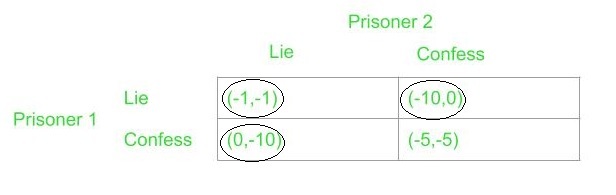
In game theory, a trigger strategy is any of a class of strategies employed in a repeated non-cooperative game.A player using a trigger strategy initially cooperates but punishes the opponent if a certain level of defection (i.e., the trigger) is observed.
- Game Theory Optimal Strategy
- Game Theory Explained
- Game Theory Optimal Strategy Poker
- Examples Of Game Theory
- Game Theory Optimal Poker Strategy
- Bidding at Auction. An auction is considered as a sale activity in which different bidders bid for.
- Game theory is a way of thinking about strategic situations. One aim of the course is to teach you some strategic considerations to take into account making your choices. A second aim is to predict how other people or organizations behave when they are in strategic settings.
- Well, obviously, throwing one third, one third, one third would be the game theory optimal approach. The problem with that is while you won't lose, you also won't win if you stick to that- unless you get lucky, of course. But that's not an exploitative strategy. Now, what if you find- you notice that your opponent throws rock a lot?
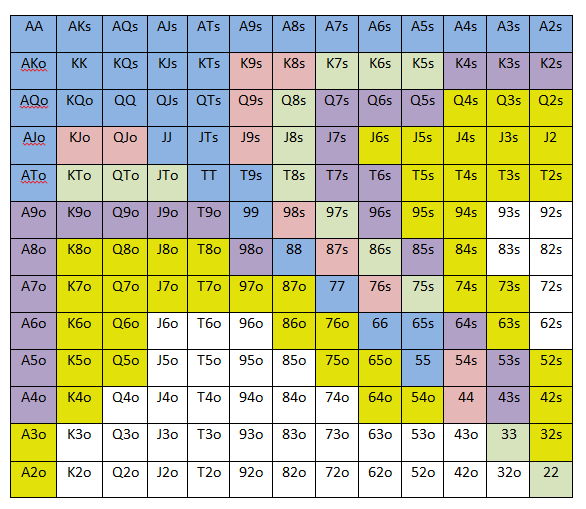
'Game Theory Optimal' — or 'GTO' — is a term often heard in poker these days. Often the term is used imprecisely as a general reference to the 'best' style or strategy in a given situation, though in truth it has a much more specific meaning than that.
To employ a 'GTO' style means to play in a way that is impossible to be exploited by an opponent. It means always making 'optimal' decisions that ensure you maximize your expected value in any situation. To play such a style perfectly would also mean that the very best your opponent could do against you would be to break even.
Such a style can be readily employed in simple games, but in more complicated ones like no-limit hold'em it is hard actually to play a strict 'GTO' style. Besides, in poker players almost always demonstrate certain tendencies that suggest sticking with a 'GTO' strategy isn't necessarily the best option — rather, an 'exploitative' style that responds to opponents' weaknesses can sometimes be a better choice.
Our Laura Cornelius caught up with a number of poker pros to ask them how frequently they themselves could be said to play a 'GTO' style. Their responses suggest the current 'GTO' debate in poker is in a way an updated version of the old 'math vs. feel' one.
Watch below and listen to reponses from Faraz Jaka, Mustapha Kanit, Luke Schwartz, Randy Lew, Fedor Holz, Jason Mercier, Celina Lin, Andreas Hoivold, and Bryn Kenney.

Game Theory Optimal Strategy
Tags
cash game strategytournament strategyno-limit hold’emgame theory optimalgame theoryGTOFaraz JakaLuke SchwartzFedor HolzRandy LewBryn KenneyRelated Players
Faraz JakaBryn KenneyRandy LewLuke SchwartzFedor Holz
In game theory, a trigger strategy is any of a class of strategies employed in a repeated non-cooperative game. A player using a trigger strategy initially cooperates but punishes the opponent if a certain level of defection (i.e., the trigger) is observed.
The level of punishment and the sensitivity of the trigger vary with different trigger strategies.
Trigger strategies[edit]
- Grim trigger (the punishment continues indefinitely after the other player defects just once)
- Tit for tat (the punishment continues as long as the other player defects)
- Tit for two tats (a more forgiving variant of tit for tat)
References[edit]
- Textbooks and general reference texts
Game Theory Explained
- Vives, X. (1999) Oligopoly pricing, MIT Press, Cambridge MA (readable; suitable for advanced undergraduates.)
- Tirole, J. (1988) The Theory of Industrial Organization, MIT Press, Cambridge MA (An organized introduction to industrial organization)
- Classical paper on this subject
Game Theory Optimal Strategy Poker
- Friedman, J. (1971). A non-cooperative equilibrium for supergames, Review of Economic Studies 38, 1–12. (The first formal proof of the Folk theorem (game theory)).